"The vaguest hint of a song-"
Released through Too Pure in 1993, Quique represents a blend of rock and electronic, combining an unorthadox variety of styles such as techno, dream-pop, ambient, and dub.
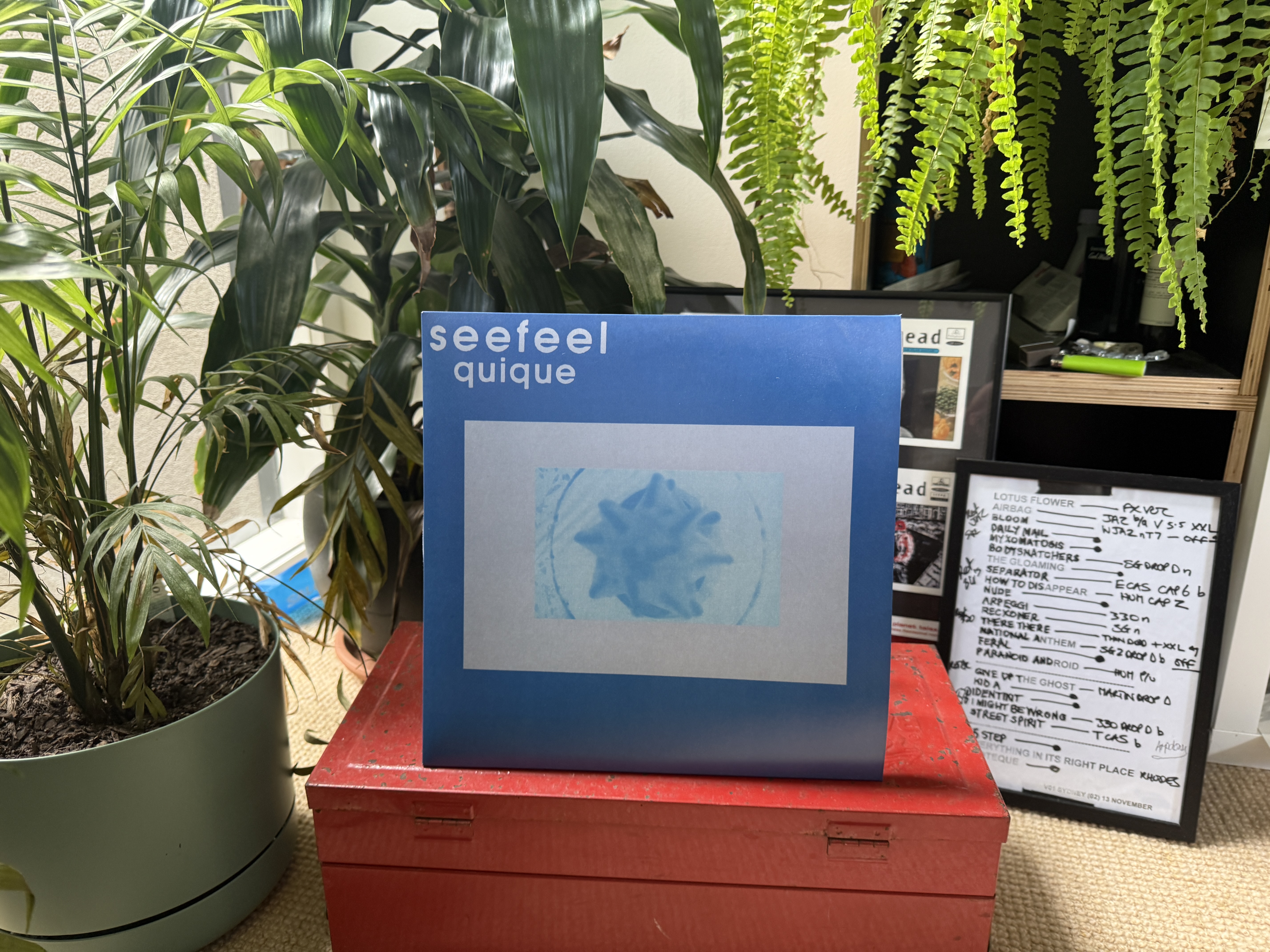
In 1993, folding post-rock’s haze into electronic process felt genuinely new; today it reads as a template others adopted. Produced in a time where genre allegiance and purity was less important, and even actively disdained, Seefeel wasn’t inclined towards pop catharsis with their debut album. The spontaneous, nascent – yet cohesive – nature of the tapestry of sounds imbued into Quique reflects Seefeel’s formation, whereby founder Mark Clifford initially advertised for members to join his collective in his university campus classifieds, bringing varied backgrounds under tow. A prominent theme in the cultural zeitgeist at the time of Quique’s inception was technological alienation – the future felt ambiguous, and releases at the time were laced with varying blends of futurism and dystopia. Genre lines blurred. Subcultures multiplied. The future didn’t seem monolithic – it seemed fractured, and that felt okay. Quique embodies this feeling, leaving the listener unsure if it was predicting transcendence or breakdown.
The early 90s marked an inflection point where experimental cohorts such as Aphex Twin, Autechre, and My Bloody Valentine occupied a tangential space unsullied by dogmatic adherence to genre conventions. Seefeel took this tangent; excitedly stretching, warping, and bending it to create timeless sonics that still sounds avant-garde today. Much of the album is characterised by repetition, microvariation, and the slow accumulation of texture, as every track breathes and unfolds into elongated ambient explorations anchored by dubby basslines. It takes several minutes for the album’s opener, ‘Climactic Phase #3’, to unravel from a soundstage comprised solely of atonal, hyper-processed guitar loops accompanied by percussion that clanks with a homemade, metallic tang, as if struck on improvised steel, to evolve into what the listener may eventually define as a song. But as the wiggling bass riff enters, and the inexorable timbre of looping guitars coalesces to reach a climax akin to radio signals projecting into outer space, the beat hits double-time and marches forwards, thrusting the listener into a fully realised sonic mosaic that could only be described as an off-world sci-fi dreamscape.
In ‘Polyfusion,’ metallic, screeching, e-bow modded guitars lurch up and down like a ghost in a gargantuan machine. Their movements are tracked by the tones of violin-esque manipulations, heavy drums, and a slow stepping dub bass, moulding a seamless entrancement tethered by sirenic voices. Seefeel is able to conjure considerable depth with the limited number of tracks utilised per song and heavy repetition of elements, however, they avoid stasis. Instead of collapsing into flatness, Quique unfurls as a kind of sonic architecture. Its layers behave less like stacked elements and more as shifting planes: some recede, others press forward, others drift in and out of focus. Sarah Peacock’s contributions in ‘Plainsong’ are perhaps the most prominent embodiment of this, her vocals not comprising vocals in the traditional sense, but rather a half-human, half-texture vapour that drifts through the track and adds an eerie luminosity to Mark Clifford’s looped guitar processing. She brings the only “human” element to music that often feels mechanical or oceanic, but she never disrupts it, she blends into the machinery.
Three decades on, Quique feels less like a genre hybrid than a method: reduce, repeat, and let the timbre do the talking. Whether it points to transcendence or breakdown is besides the point - it proves those futures can sound the same.